Kitchen Loves
Dear Lovely,
I began my journey as a cook in 2003 when I lived in Florence, Italy as an exchange student. Inspired by the local cuisine and somewhat desperate due to the fact I couldn’t rely on my mother or the university dining hall to feed me, I ventured into the creative practice of melding flavors, and ever since I’ve loved spending time in the kitchen. I remember the first meal I ever made in Italy. My roommates and I purchased chicken, pasta, cheese, and a bottle of white wine from the Mercato Centrale, an indoor vendor market which happened to be directly across from my apartment on Via San Antonino in central Florence. Think an indoor farmer’s market with old Italian men selling produce, meats, cheeses, pastas, spices, wines and anything else of a culinary dream.
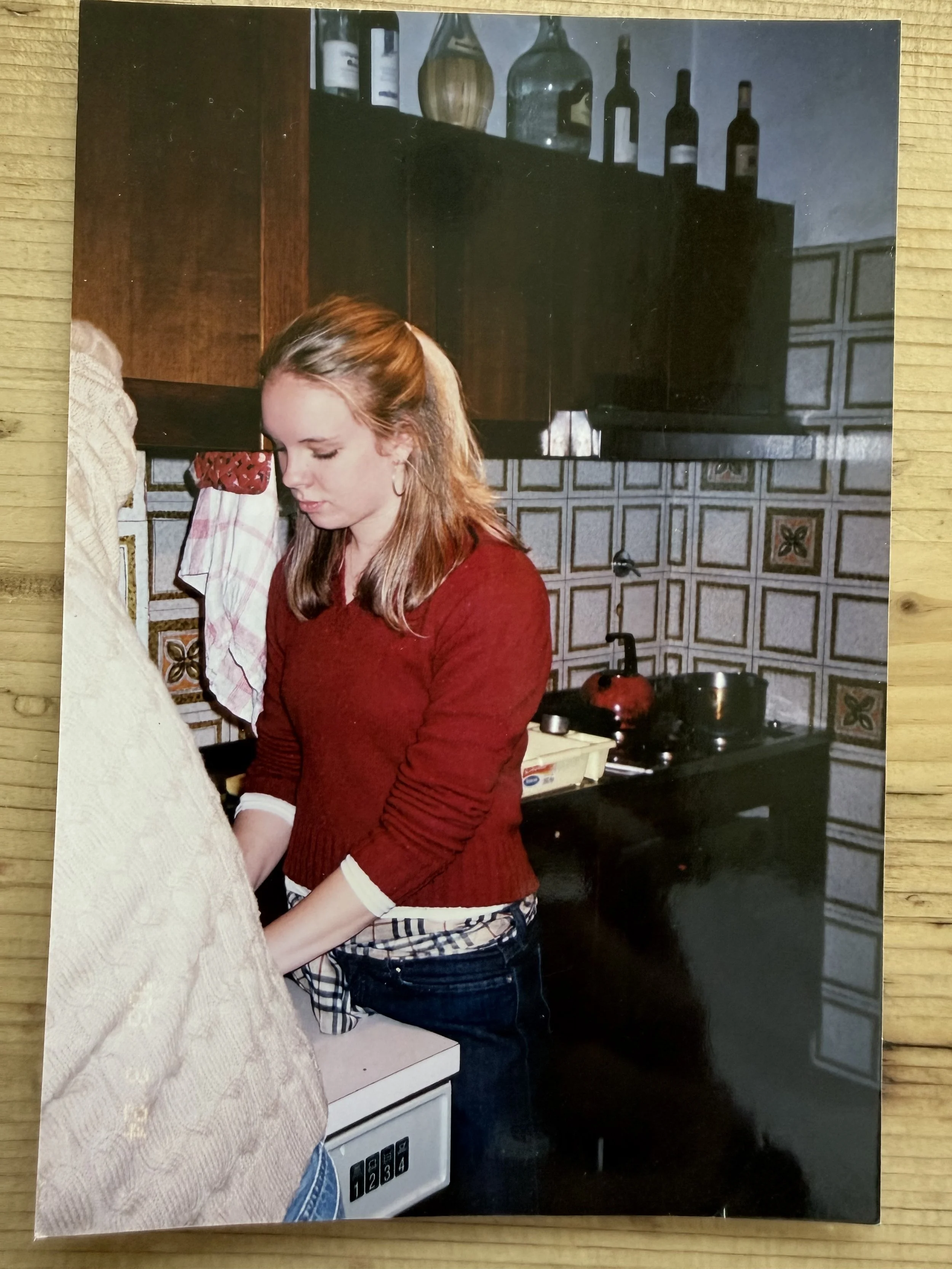
Here is a photo of me at 20 in the kitchen of my little Italian apartment cooking. Look how young I was! ☺️ The date is March 24, 2003.
With zero experience but plenty of hunger, we sautéed the chicken in a pan with only a bit of oil—on a burner we had to physically light with a match—and then randomly decided to pour a splash of white wine over the meat as it cooked. I don’t remember thinking the meal was especially delicious once we finally sat down to eat, but somehow using a method I would later come to know as braising gave me permission to be brave in the kitchen.
In the 23 years since that first attempt at cooking, through trial and error, I have cultivated a list of helpful kitchen items that I can rely on. Having tried and true tools in my arsenal allows me to be brave, and I have funny little connections to all of them. I think for those of us looking for meaningful lives, we naturally connect with or want to feel connected to the choices we make, including the products we rely on. Connection equals meaning, reason, and outcome. I connect to quality. I connect to tradition. I connect to natural materials.
This list is not full of gadgets. A food writer once told me that most tasks in the kitchen can be done with a pairing knife, and you know what, she’s right! Real cooks have no need for gadgets, such as a little device used to remove stems from strawberries. Just use a pairing knife. Gadgets junk up kitchen cabinets and drawers, break easily, and often wind up in landfills. The other day, I saw someone post her “Amazon favorites” on Instagram and it included a little fan, shaped like a cat, that would blow air on your hot food to cool it off before eating. I literally have no words.
I believe the kitchen can be considered a place of worship, a place where we can give thanks for all of the Lord’s provision. Exodus 16 explains the story of the Israelites complaining to Moses about a lack of food, and God responds by providing manna each morning. Bread literally rained like dew from heaven to feed the Israelites. God always provides our daily bread according to His will.
‘At twilight you will eat meat, and in the morning you will be filled with bread. Then you will know that I am the Lord your God.’
Exodus 16:12
This list of kitchen essentials are high quality, durable, and help me accomplish my numer one kitchen goal: For our kitchen to be the heart of our home. To accomplish this goal, I do 2 things
make flavorful, fragrant, and nutritious meals for my family and friends
create an environment in our kitchen that is always welcoming
*One of the ways I do this is to almost always having music playing. I’m old school and still use Pandora. I love this French Cafe Radio Station. I also love Spanish Guitar Radio and Jason Mraz Radio.
These are the tools that help facilitate the elements that make our kitchen the heart of the home. I know they will help you too.
For utensils, I prefer to cook with only wooden spatulas as opposed to anything plastic. I purchase these most often from independent woodworkers when I come across them at an open-air market or farmer’s market. Very rarely do I pass up a new wooden utensil if I see one and therefore have a nice collection in a wide range of shapes and sizes. My most favorite ones are made from olive wood or acacia wood.
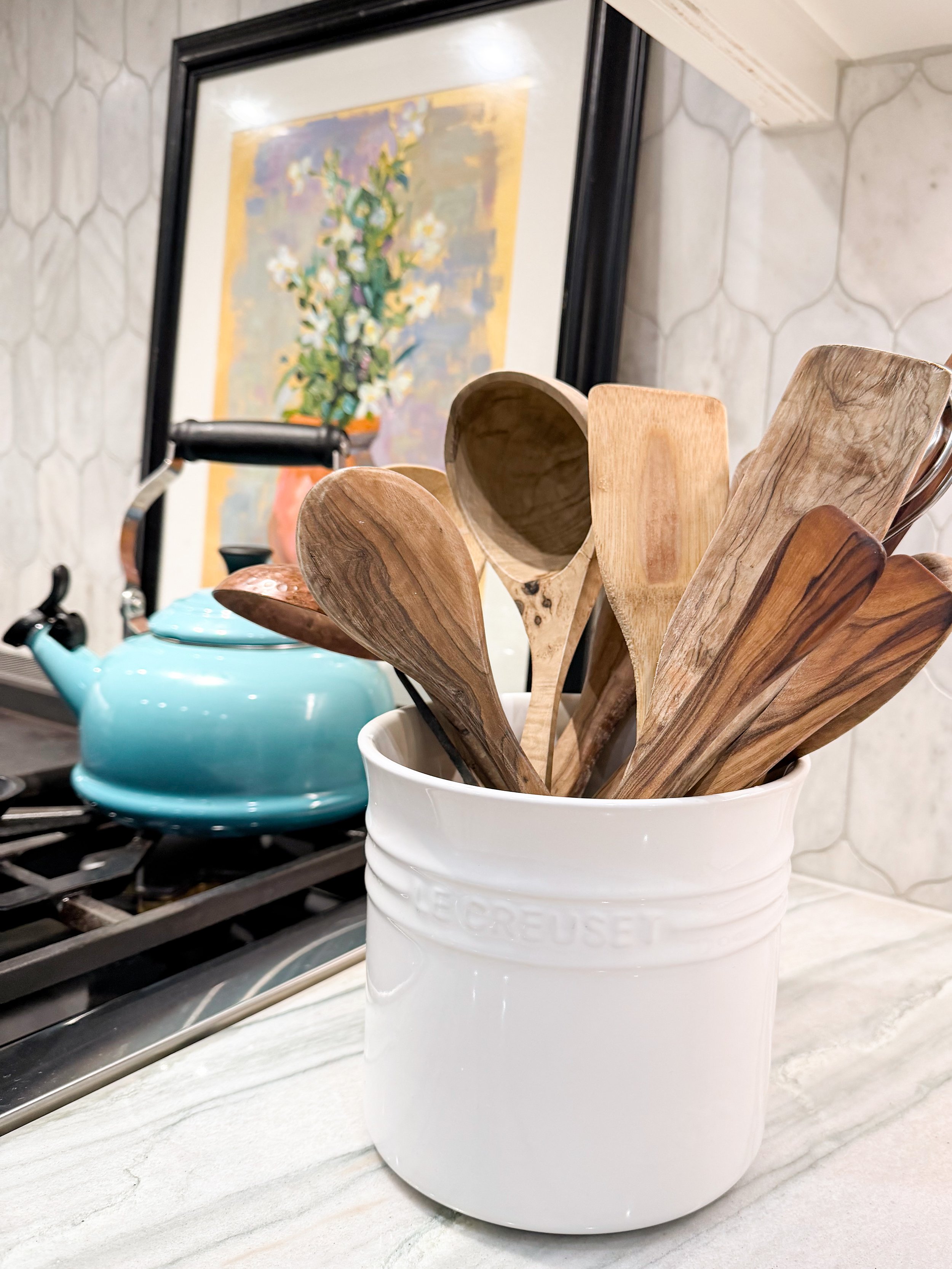
Why wood?
our world is in a plastic crisis. too much plastic already exists on the planet, so we must cut down on the demand to slow the crisis.
plastic can break down when used with heat and can get into our food, meaning we ingest little plastic pieces. gross.
wooden utensils just look prettier to me while sitting out on my kitchen counter.
FYI: I use the wood conditioner from The Standard to clean and condition my wooden utensils and cutting boards. Wood and water don’t mix well, so after use and washing, the wood can become dry and dull looking. Wood conditioner combats the dryness and restores hydration and richness.
For a basic skillet, I prefer to use a copper pan. Mine is from a set my mom had for years, although she never cooked with them—they just hung as decoration in her kitchen. When she remodeled and changed her kitchen décor, I took them with the intent on learning how to cook on copper pans. Turns out, I love them! I don’t have a modern brand that I can recommend based on usage, but when I am ready to replace what I have, I’ll be looking at antique malls and probably at Round Top. Anything made in the past tends to be higher quality anyway.
When shopping for copper pots, look for pieces that are at least 2mm thick. This will help the heat to distribute evenly. Copper is heavy, so the pot should have some weight to it. Also, check the lining of the pot. Copper can react with acidic foods and give them a metallic taste, so check for a lining like stainless steel or tin.
Why copper?
As you probably know, copper is an excellent conductor of heat, so these pans are ready to cook very quickly after turning on the fire. I clean them with my regular dish soap and water, but if the copper needs some extra love, I learned from my friend, Lorie Fangio that Copperbrill is the best. (Lorie has an excellent blog post about cooking with copper pots.)
A bare cast iron skillet is such an essential for our family. My 16-year-old actually takes it outside and puts it on the Green Egg to chicken fry venison, and to make bacon or breakfast sausage. My cast iron skillet is made by Smithey. If you’re local, get your Smithey at The Standard in Downtown McKinney. If not, you can purchase through Sur La Table.
Why: There’s something about a cast iron skillet that brings additional soul to your food, not to mention it is excellent in carmelization, creating crispy crusts, and rich flavor. Smithey cast iron skillets are made in South Carolina, are uncoated, pre-seasoned, and can be washed with soap and water. I use the cast iron soap, oil, and scrub from The Standard to keep my skillet in beautiful condition. If cared for properly, cast iron skillets can be passed down through generations.
For any type of soup or stock or liquid, I prefer to use Le Creuset. Le Creuset has been making enameled cast iron cookware since 1925 at its foundry in Northern France. During the winter season especially, I have a variety of soups and chili on rotation, therefore I use my Le Creuset pots several times a week.
Why? Enamaled cast iron requires no “seasoning” and cooks acidic foods with ease, unlike bare cast iron.
Signature Chef’s Oven-this is best used for a soup or pasta that is accompanied by large pieces of meat. I am publishing a second Substack this week with a fantastic winter soup recipe (plus 3 recipe hacks!) and I used this pot.
Signature Round Dutch Oven-best for slow cooking and can even be used to make a boule of bread! If you have only used actual CrockPots for slowcooking, you should know that you can slow cook in an oven too. A “low” setting would be to cook at approximately 200 degrees, for 6-7 hours; a “high” setting at around 300 degrees for 4-5 hours. The knob that comes on the lid is good to use in the oven for up to 500 degrees, just FYI.
Stock Pot-I use this for very large batches of soup or if I’m actually making stock. Also good for seafood boils.
Mini Cocotte-my favorite dish to make in these tiny casseroles is Oeuf Cocotte, but they are also great for making individual deserts.

Le Creuset is known for the fun colors of their enameled cookware. I prefer my large pieces to be white but have my mini cocottes in several different colors.
A good set of knives is a necessity in every kitchen. I choose to use a brand called Wüsthof but there are lots of wonderful brands out there. Wüsthof knives are made in Solingen, Germany and have been for the past 200 years! Wüsthof is still family owned after all that time, staying true to their ethos that quality knives can only be made when high-precision production meets traditional artisanship. Love this ethos.
The knives I cannot live without are:
I know this one has mixed reviews because it is so big and heavy, but I use mine. I use it much more in this kitchen than in my previous house because I have the room to always leave it out on the counter, but I have friends that prefer to use a hand mixer to attain the same results for much less space, not to mention less $$$. The difference is this: with the addition of small attachments, a KitchenAid Stand Mixer can also be used to make pasta and spiralize veggies, two things I happen to make. Therefore, if you don’t have other machines for those two dishes (or perhaps you do) everything can be consolidated with this one appliance. Mine was given to me for Christmas by my mother-in-law in 2006 and it still works perfectly. These are expensive machines but long lasting. FYI: I’ve linked several of these appliances to Belk.com because they often have really good deals!
For years I used an actual kettle and boiled water on the stove when needed, but after traveling to Provence in 2023, I stayed in a hotel that provided a Smeg Electric Kettle in every room to use with the assorted teas they left complementary, and I loved the convenience. The Smeg Electric Kettle comes in two sizes, the 3-cup and the 7-cup. I have the 3-cup and it is the perfect size for our needs. FYI: I’m not here to tell you what type of toaster to buy, because honestly, I believe most toasters are created equal. However, I have a toaster also made by Smeg and love it.
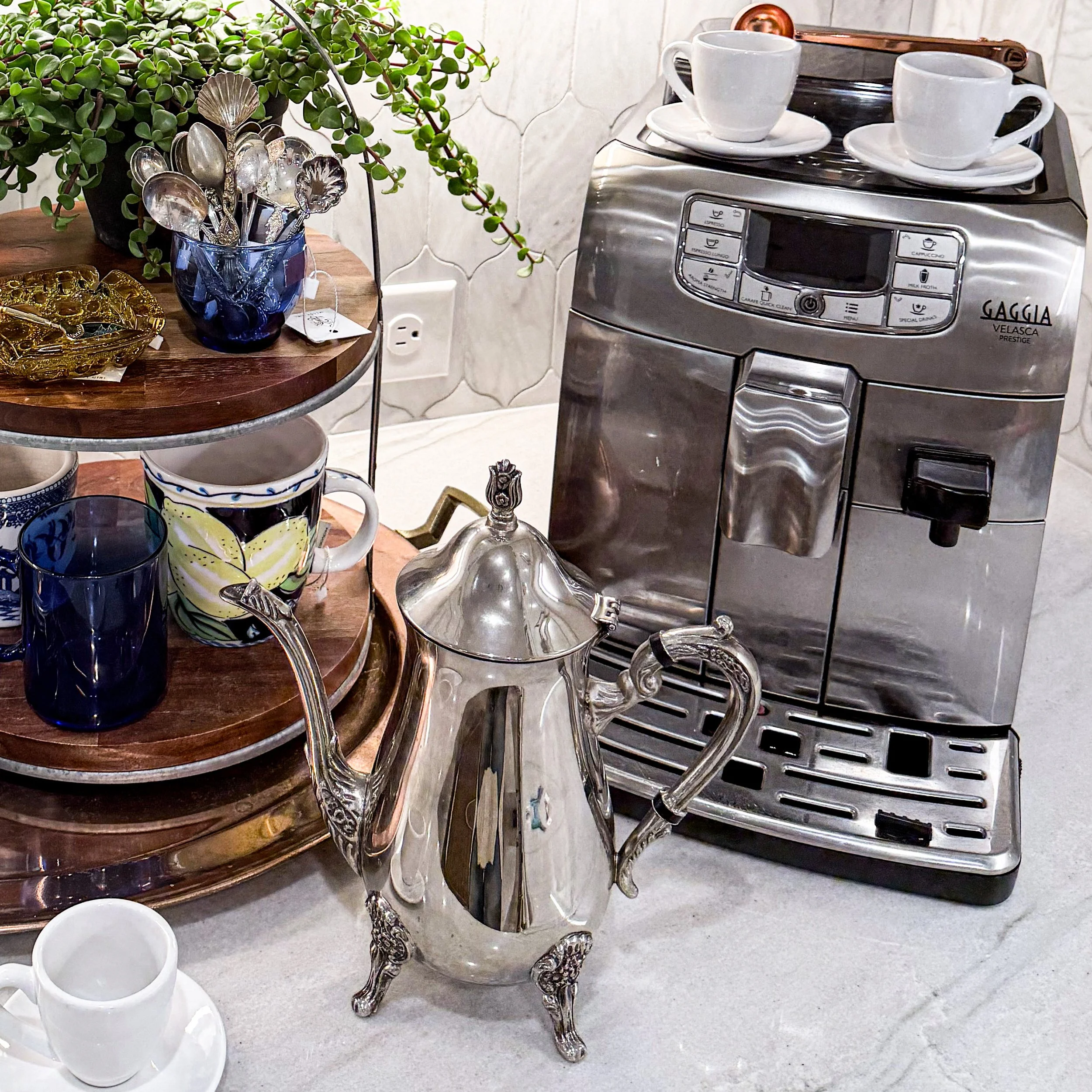
Gaggia Velasca Prestige Coffee Maker
I was introduced to this coffee maker by my brother years and years ago, so when I was ready to upgrade to a big girl coffee maker, this is what I went with. Over time, they’ve come out with updated versions, but I still love the original. I’ve had one problem with it since I purchased it—some internal part needed replacing—and they sell a replacement part kit, which I purchased, and haven’t had another problem since.
I love that this coffee maker will make one cup at a time.
I love that it can steam milk.
I can make espresso.
I can make capuccinos.
I can select how strong I want the brew.
I love that it was made in Italy.
It uses whole beans, but I don’t have to grind them and then tamp them down or do other official barrista things. I just pour the beans in the machine and it does the rest.
The Gaggia Velasca Prestige requires 2 “things” that I DON’T do.
The water reservoire has a spot for a specific water filter that needs to be replaced every few months, depending on how often you use the machine. It’s made of plastic and since plastic is rarely actually recycled, I didn’t like having an additional bit of trash each month. Well, ding ding ding, I recalled that I only use filtered water to fill the water basin anyway, therefore, do I really need an additional water filter? I decided that no, I don’t, so I stopped using one. This cuts the cost of continuously purchasing water filters as well as cuts down in waste.
After a certain amount of cups of coffee are brewed, the machine requires something called a calcium clean, and a bottle of cleaner needs to be purchased and then run through the calc clean cycle. Well, I decided that instead of using some chemical cleaner, I would use white vinegar. Again, this cuts down in cost in having to purchase additional cleaner while also omitting the need for one more plastic bottle. I know it may seem trivial—what’s one less plastic bottle going to do?—but if we all use one less plastic bottle, big things can happen!
DISCLAIMER: Because this is the internet, I feel I need to say that choosing not to follow the rules dictated within the users manual of any machinery you purchase and use could result in the machine not working properly or lasting as long as it should. Your good judgement is always required when making decisions for your life.
Okay Beautiful, when it comes to kitchen essentials, these are the basics I use to facilitate my life as a home cook. To my fellow home chefs, I’d love to know what your favorite products are. What things make your culinary lives easier? Big or small, what products are tried and true? Also, would you like a post about pantry essentials? Or most used cookbooks? Talk to me, friends.
And as always, if you know someone who would appreciate this post, please forward it to them.